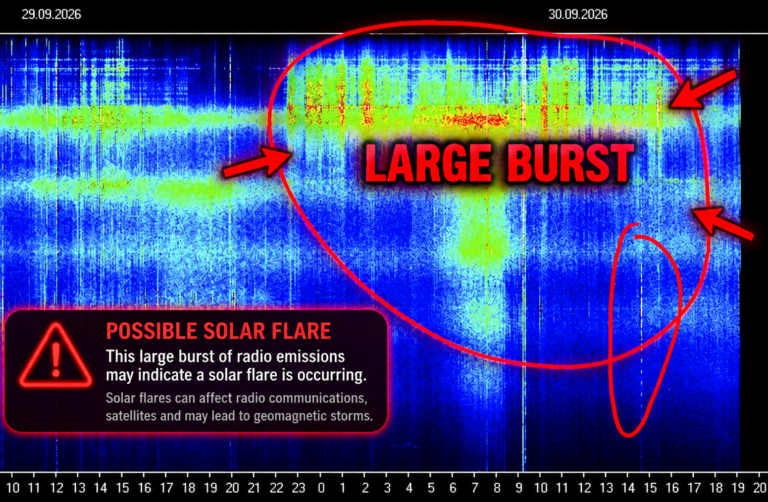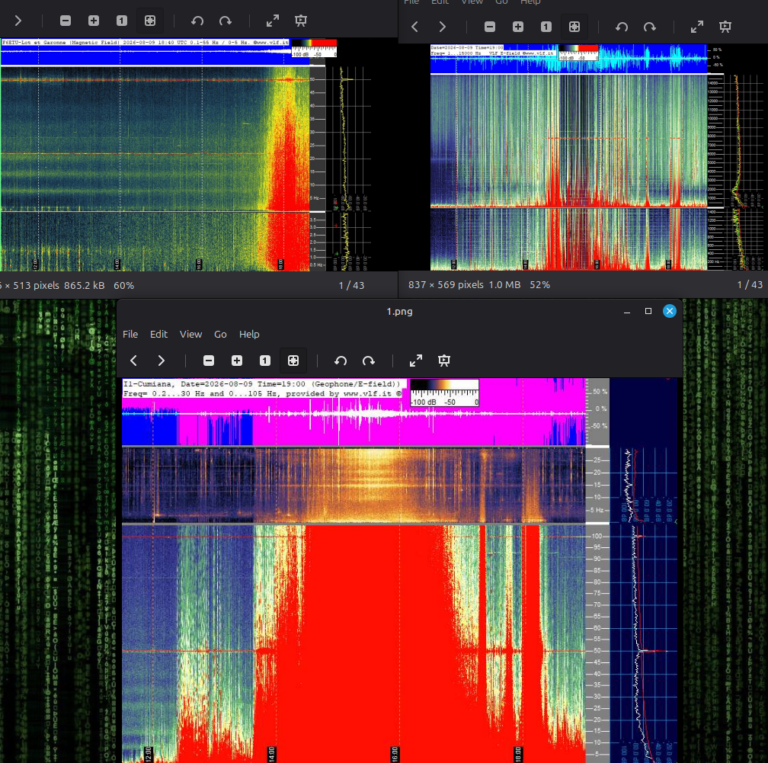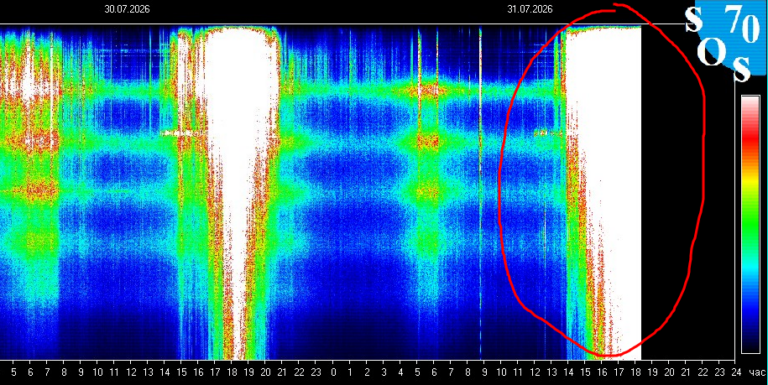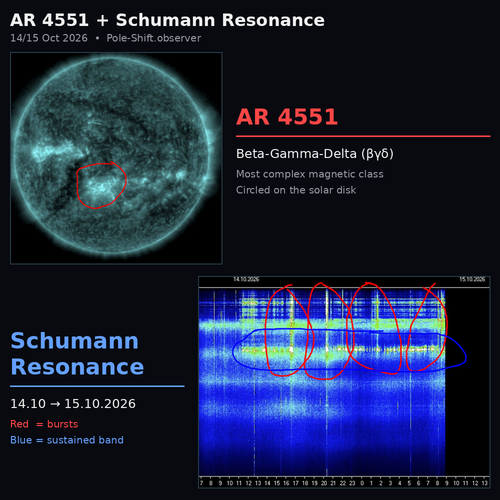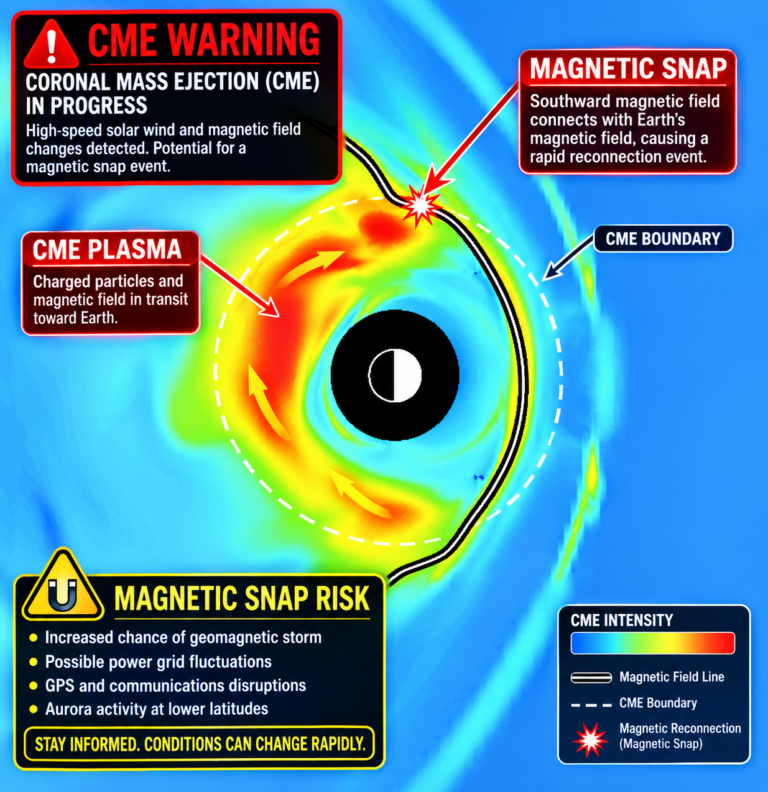
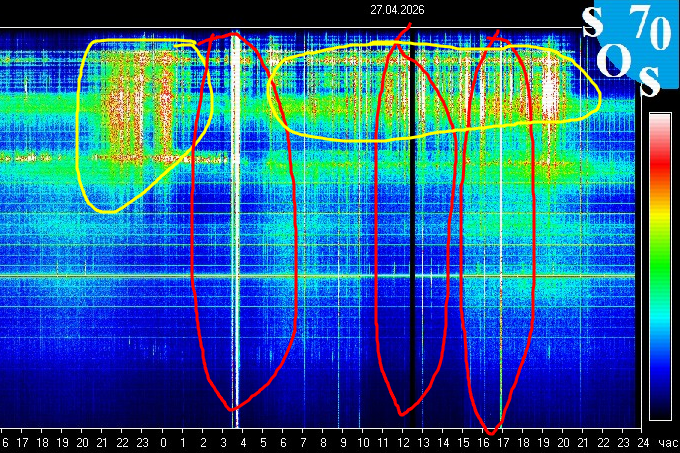
The calm before the storm. NOAA and NASA has released a statement of an incoming Earth-directed X-Class flare. From the looks of the Tomsk Schumann Resonance, this maybe correct.

There is two regions showing converging magnetic energies which are ready to burst.
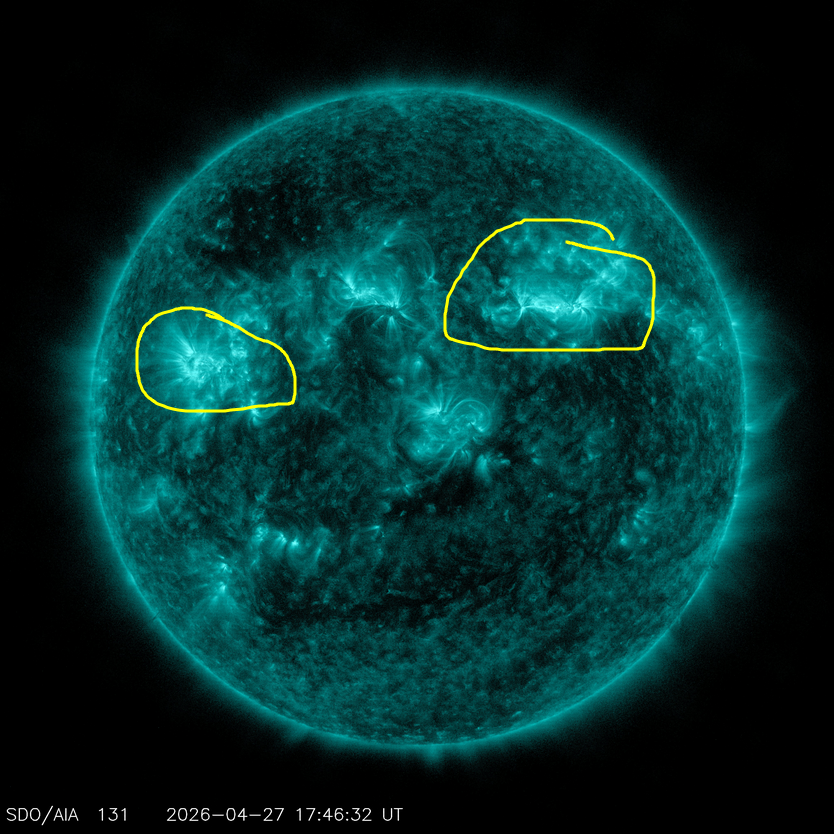
M-Class flaring continues today but a chance for an X-class is also on the watch. At the bottom is the NASA discussion which shows the forecast.
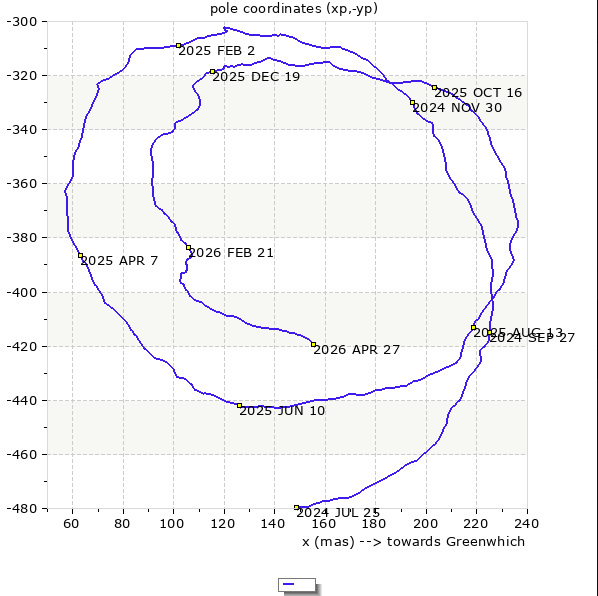
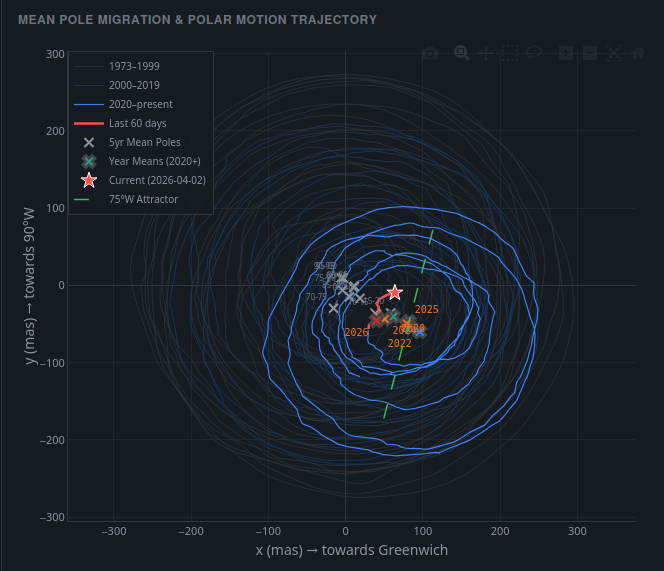
New data of the wobbling effect and tilt shows that an intersecting familiar pattern will emerge in June. We can expect major magnetic fluctuation this summer. And again in November.
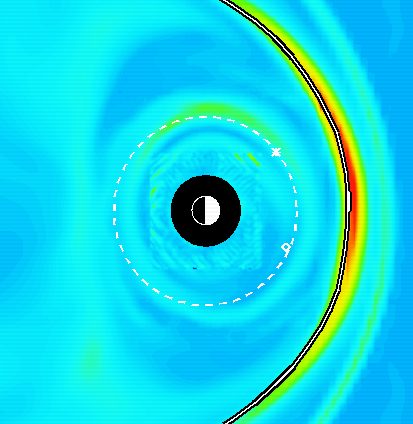
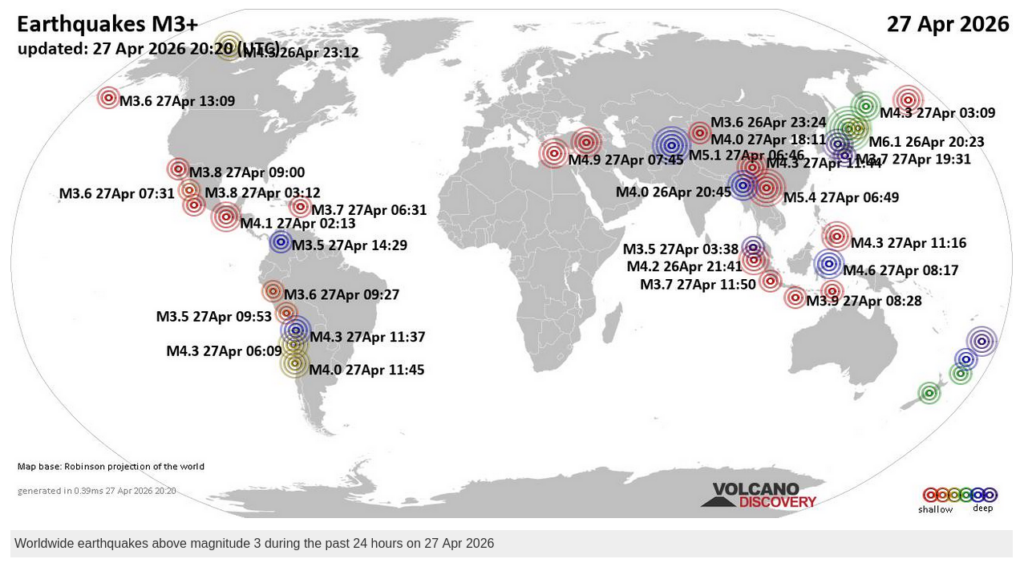
This brings us to the constant geomagnetic disturbance around our planet. High density is pushing in from the Sun and with tonight arrival of the PANSSTAR comet tail, it would be interesting to see how Earth will react.
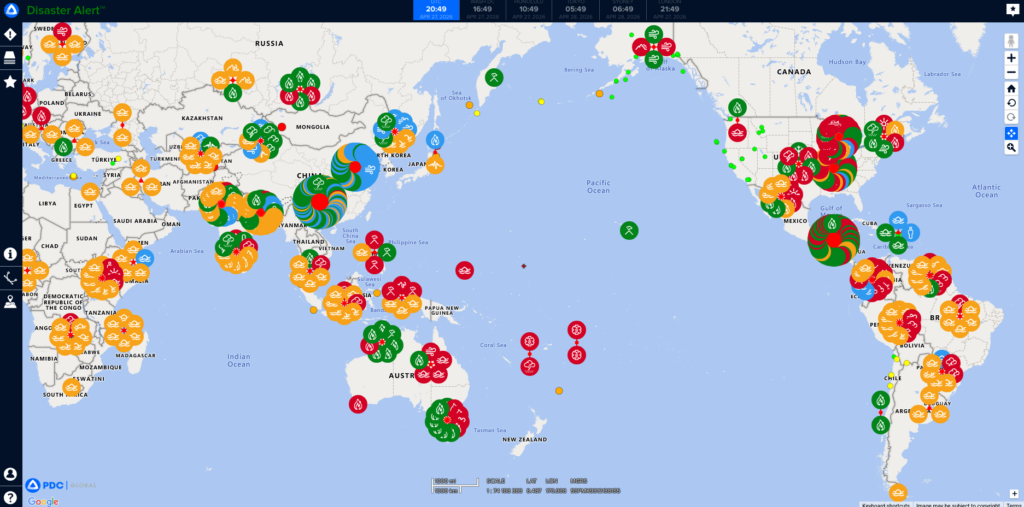
There are 540 current active climate disasters.
:Product: Forecast Discussion
:Issued: 2026 Apr 27 1230 UTC
# Prepared by the U.S. Dept. of Commerce, NOAA, Space Weather Prediction Center
#
Solar Activity

.24 hr Summary...
Solar activity reached high levels as Regions 4420 (N16W23,
Fkc/beta-gamma-delta) and 4425 (N04E43, Eac/beta-gamma-delta) continued
to dominate flare production. Region 4420 produced an M1.4 (R1-Minor)
flare at 26/1403 UTC, an M1.7/1f (R1-Minor) flare at 26/1924 UTC, and an
M6.0 (R2-Moderate) flare at 26/2257 UTC. This event had an associated
Type II radio sweep (est. 834 km/s) and an F10cm (260 sfu) radio burst.
Despite the indications, no evidence of an associated CME was observed
in coronagraph imagery. This region added several C-class flares as
well.

Region 4425 contributed an M2.2/1n (R1-Minor) flare at 26/2004 UTC, an
M1.0/Sf (R1-Minor) flare at 27/0645 UTC, and a notable C9.7/Sf flare at
28/1803 UTC. Region 4420 exhibited some reorganization in its leader
spots with minor decay in its intermediate spots. Region 4425 continued
to grow and evolve, adding several intermediate and trailing spots. Both
spot groups maintained their delta magnetic configurations.

The remaining regions were stable or in slight decay.

.Forecast...
Solar activity is expected to be at low levels, with a high likelihood
to reach moderate levels (R1/R2-Minor/Moderate), and a slight chance for
X-class (R3/Strong or greater) events through 29 Apr, due primarily to
the complexity of regions 4420 and 4425.

Energetic Particle

.24 hr Summary...
The greater than 2 MeV electron flux at geosynchronous orbit was at low
to moderate levels with a peak of 573 pfu at 26/1700 UTC. The greater
than 10 MeV proton flux at geosynchronous orbit was at background
levels.

.Forecast...
The greater than 2 MeV electron flux is anticipated to reach moderate to
high levels 27-29 Apr under persistent but waning influence of a
positive polarity coronal hole high speed stream (+CH HSS). There is a
slight chance the greater than 10 MeV proton flux could reach S1 (Minor)
levels, but is mainly expected to remain at background levels 27-29 Apr.

Solar Wind

.24 hr Summary...
Solar wind parameters continued to reflect +CH HSS influence with
possible weak transient effects mixed in. Total magnetic field (Bt)
began the period at approximately 8 nT, saw a low of 2 nT, and
fluctuated the latter half of the period between 3-6 nT. The Bz
component was mostly northward at the beginning of the period, then
fluctuated between +/- 5 nT for the remainder. Solar wind speeds
generally averaged near 455 km/s, with a brief periods closer to 485
km/s. Phi oscillated between positive and negative orientations for most
of the reporting period.

.Forecast...
Solar wind parameters are expected to return to near-background levels
on 27 Apr into 28 Apr. An increase in activity, with the onset of a -CH
HSS, will likely bring enhancements back to the solar wind environment
late on 29 Apr due to the anticipated arrival of a CIR ahead of a -CH
HSS.

Geospace

.24 hr Summary...
The geomagnetic field was quiet to unsettled.

.Forecast...
An isolated active period is still possible on 27 Apr as +CH HSS
influences gradually wane. A return to mostly quiet conditions, with
possible isolated unsettled levels, is expected by 28 Apr. Unsettled
conditions are anticipated late on 29 Apr with the arrival of a CIR
ahead of an anticipated -CH HSS.
About The Author