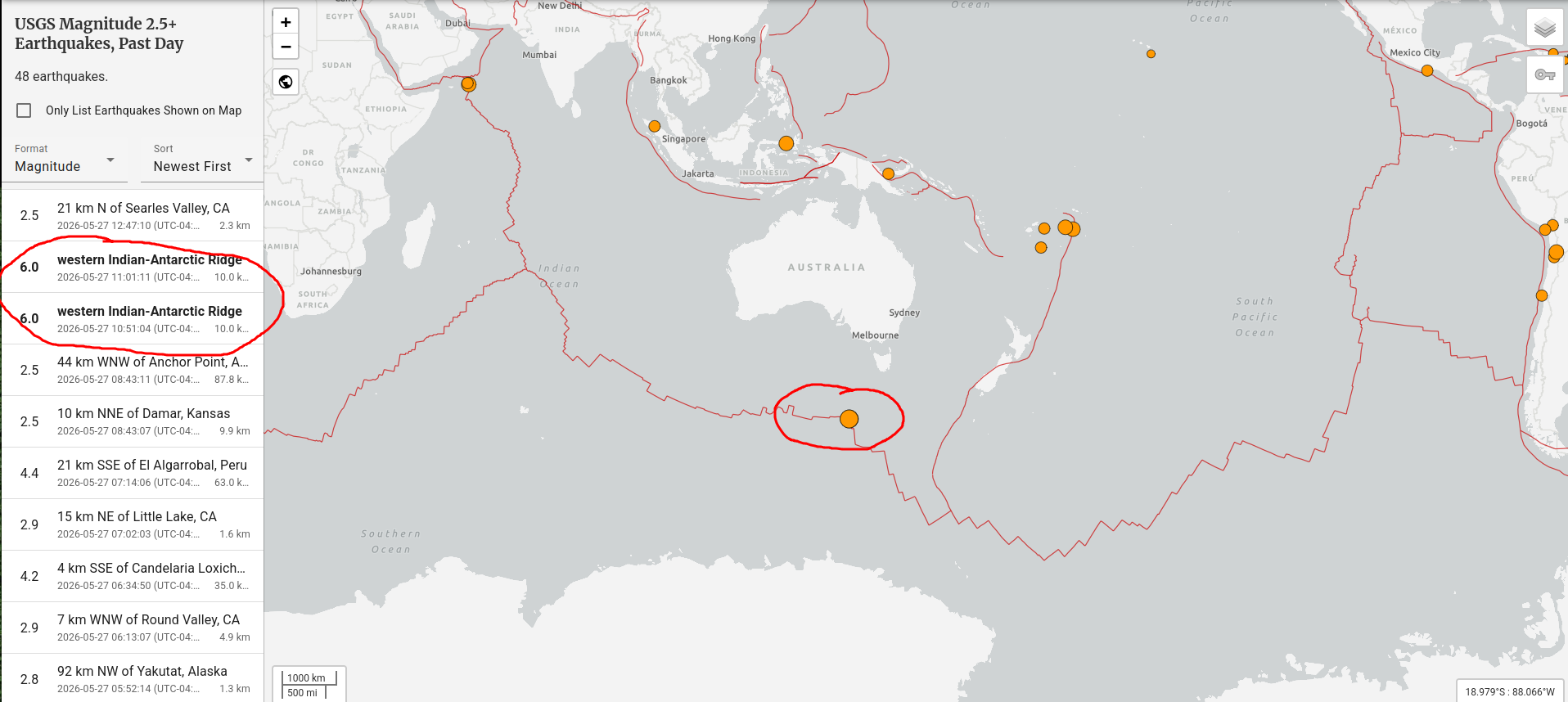
An impressive double M6 quake striking the Indian-Antarctic ridge today back to back indicating destabilization in the plates of that area.
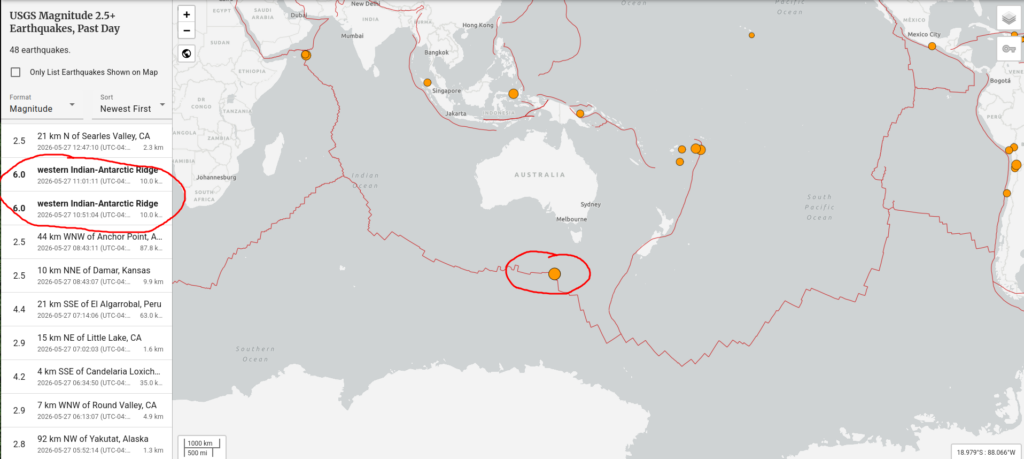
Just after a M6.9 strike Chile Early yesterday, we will see more M6 quakes popping up soon.
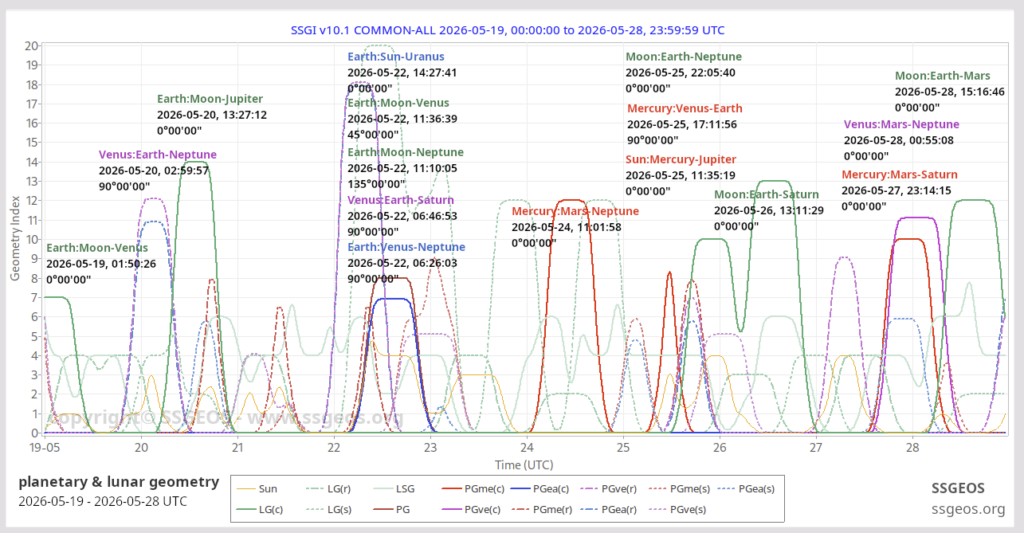
As the geometry of Moon-Earth-Saturn leaves its place, Tomorrow night we see the Moon-Earth-Mars takes place.
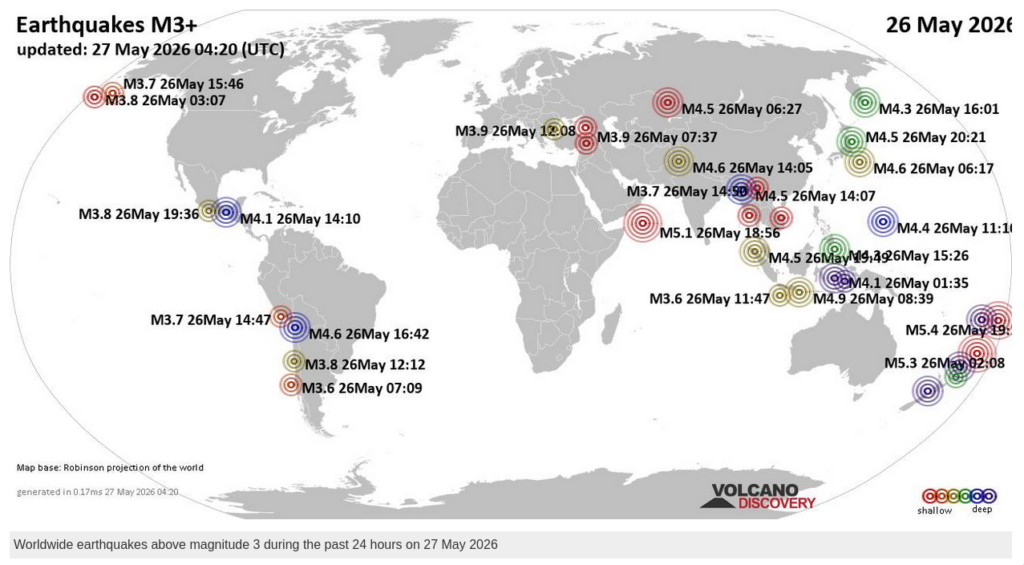
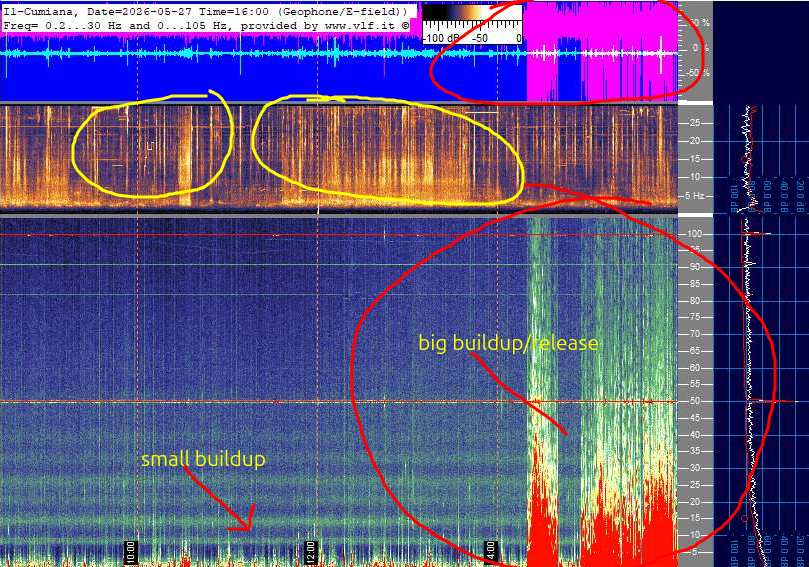
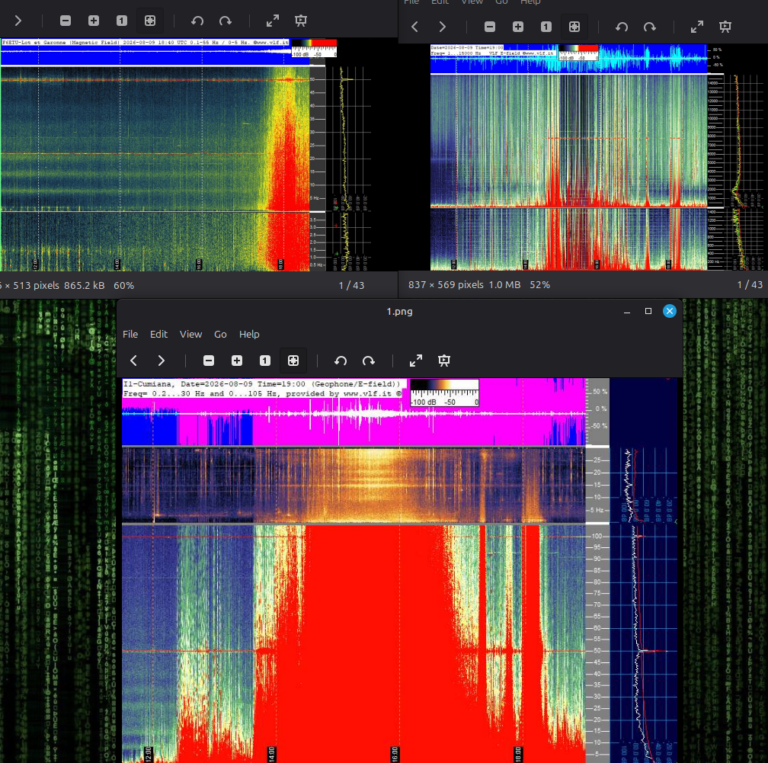
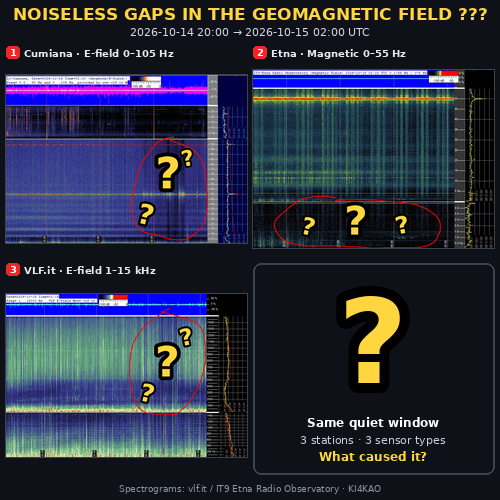
The Schumann in Cumiana does indicate a low buildup to large buildup. M6 quakes with little M4-M5 will be rising in the next 48 hours. As of this posting, another M6 quake struck the same area which further proves the destabilization of the region that will effect the other side of the plates soon.
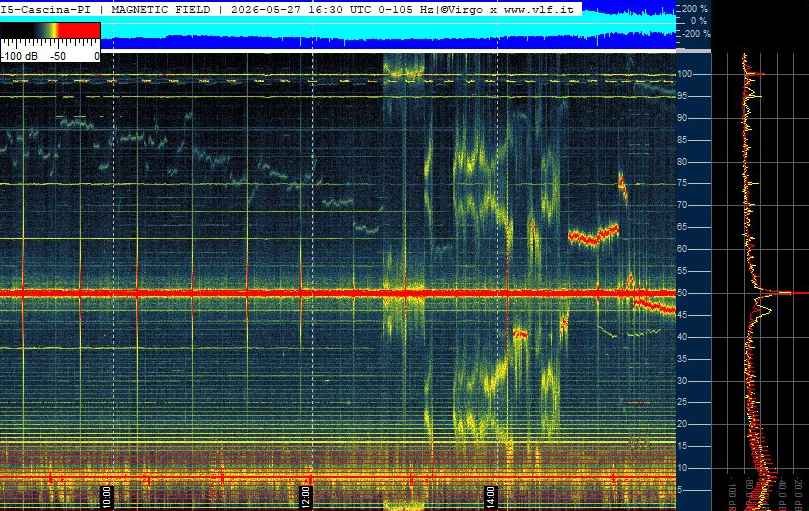
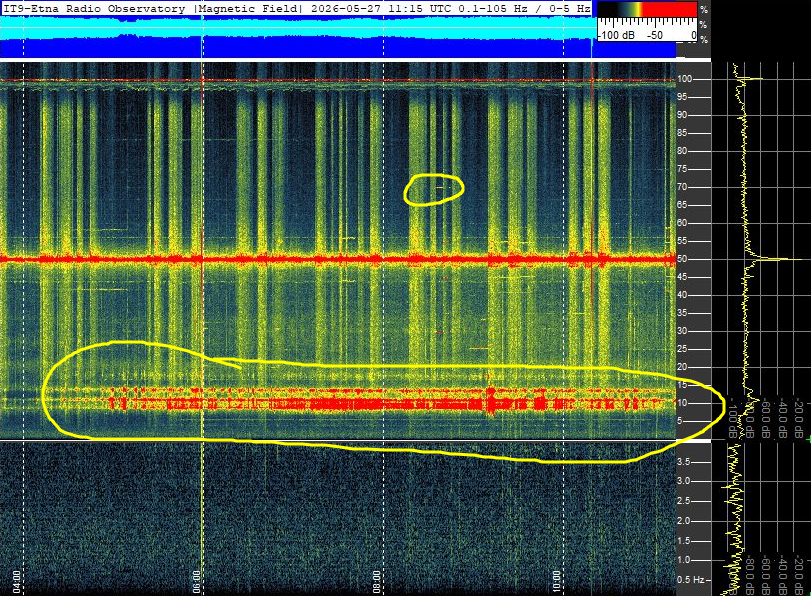
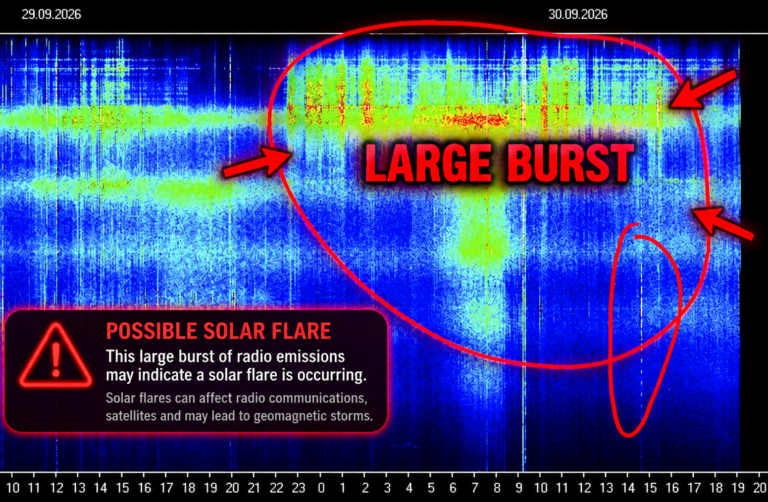
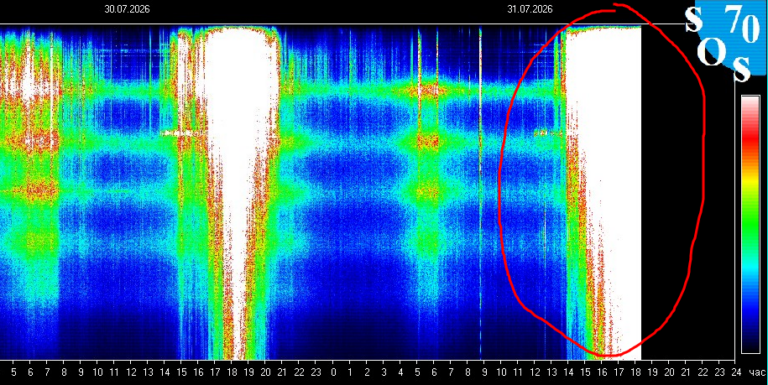
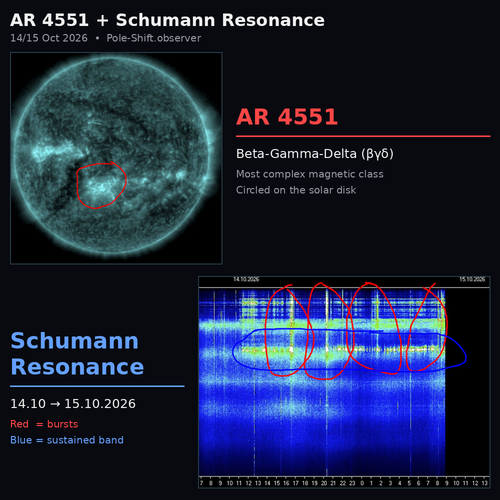
Speaking of the Schumann, we have plenty of anomalies in the atmosphere along with noise around the globe. Wether this is the result of the extra protons Earth bathed in few days ago does appear to be related but the radiation in the atmosphere above North America does appear to be declining.
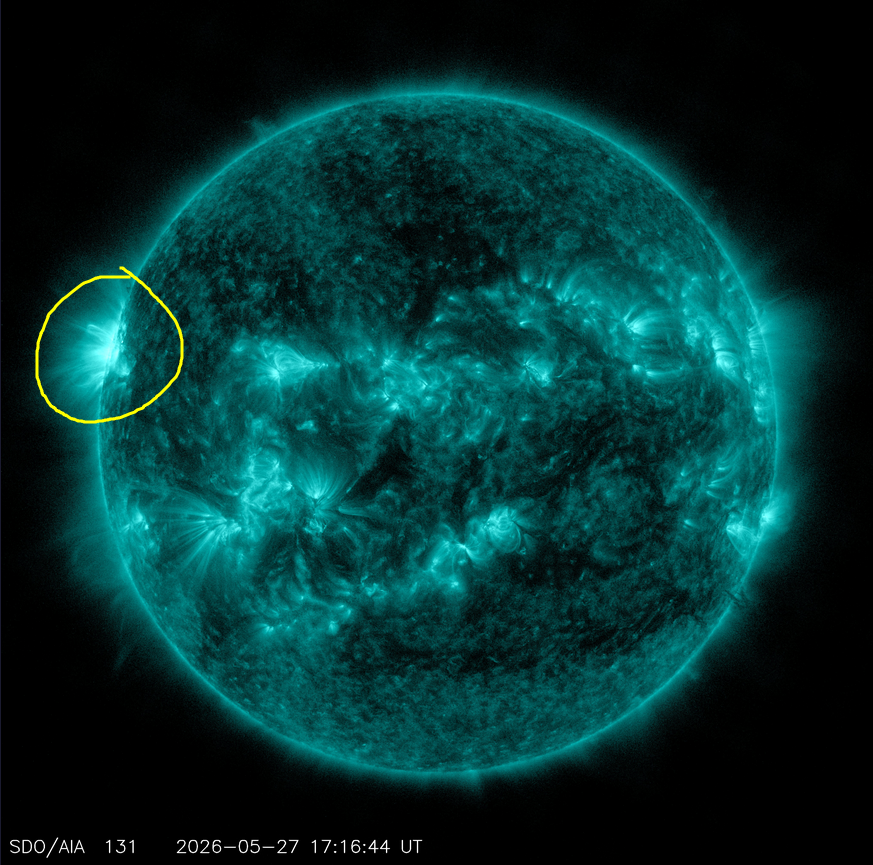
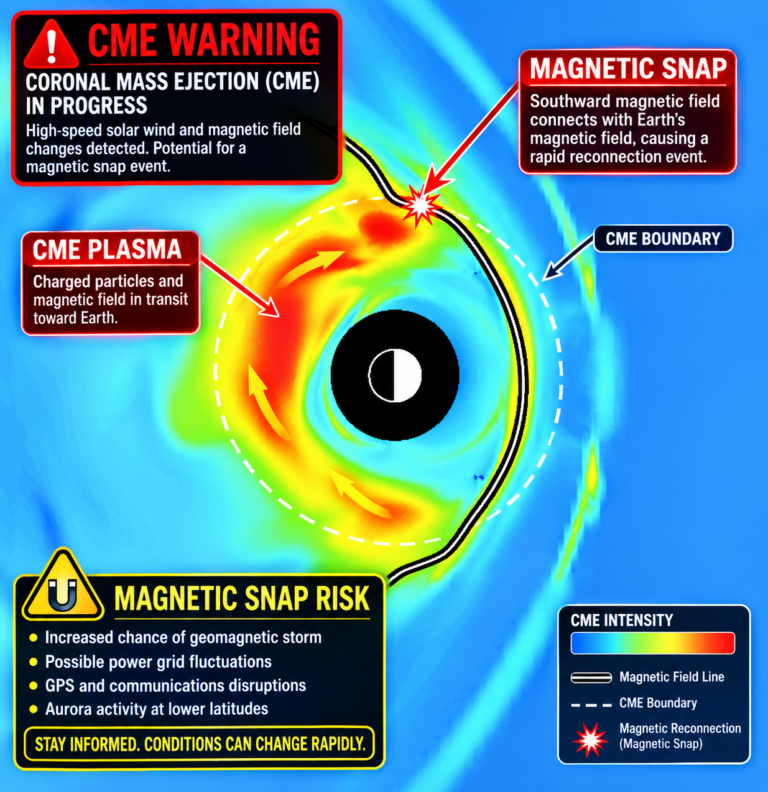
The sun remains calm with CME’s and flaring on the far side but a massive sunspot is not turning around the limb that may contribute to a rise in activity. Stay Tuned for more information.
More News:
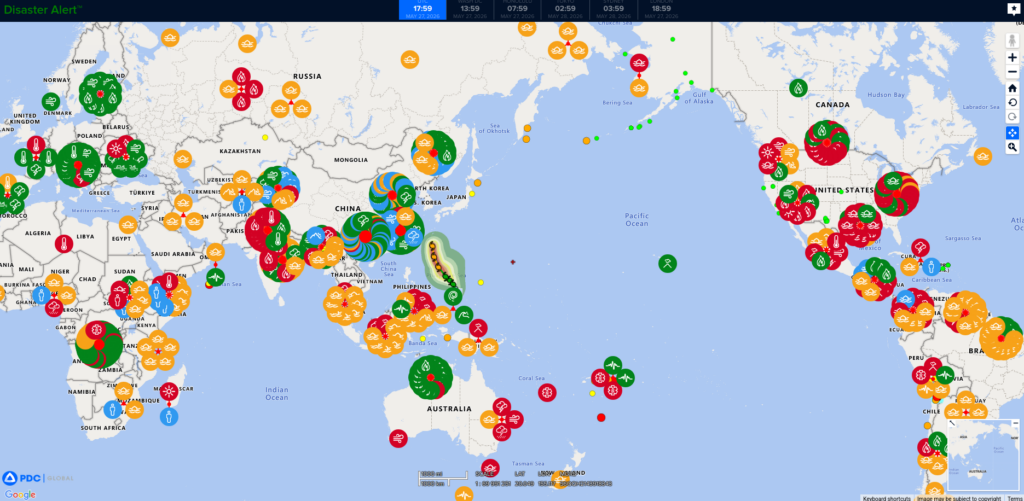
There is 561 active climate alerts on the planet:
:Product: Forecast Discussion
:Issued: 2026 May 27 1230 UTC
# Prepared by the U.S. Dept. of Commerce, NOAA, Space Weather Prediction Center
#
Solar Activity

.24 hr Summary...
Solar activity remained at low levels. The largest event of the period
was a C9.7 flare at 26/1238 UTC from Region 4446 (S16E29,
Fko/beta-gamma). This region was responsible for the majority of the
flare activity, though several occulted flares were observed on the
northeast limb where a new sunspot group is currently in the process of
rotating onto the visible disk. There is insufficient imagery available
to formally analyze this region, however, farside imagery and
helioseismology suggest a somewhat significant region.

There are nine numbered regions on the visible disk. Region 4447
(S16W15, Dsi/beta) remained stable in physical extent with some minor
consolidation noted in its trailing spots. Region 4452 (N09W21,
Cai/beta) continued to show rapid growth in both extent and intermediary
region. The remaining regions on the visible disk were relatively simple
and were stable or in gradual decay.

A Type II radio emission beginning at 26/1244 UTC is believed to be
associated with the C9.7 flare, with an estimated shock velocity of 650
km/s, and subsequent fieldline movement is visible in GOES/SUVI 284.
However, any associated CME was too faint or narrow to be detected in
available coronagraph imagery.

A very faint, potentially partial halo, CME is visible in LASCO C2
starting at around 26/2230 UTC, and then subsequently in GOES/CCOR1.
There is little obvious on-disk source for the eruption, and STEREO has
a data gap in that time frame, so triangulation is not possible.
Analysis is currently ongoing.

.Forecast...
Solar activity is expected to be at low to moderate levels through 29
May. There is a chance for isolated M-class flares
(R1-R2/Minor-Moderate) due to the eruptive potential of the various
sunspot groups in the southeast and the anticipated rotation of one or
several active regions onto the visible disk.

Energetic Particle

.24 hr Summary...
The greater than 2 MeV electron flux at geosynchronous orbit was at low
to moderate levels, with a peak flux of 455 pfu observed at 26/1715 UTC.
The greater than 10 MeV proton flux at geosynchronous orbit began the
period gradually decaying from the S1 (Minor) solar radiation storm
levels of the last UTC day, driven by a large far-sided partial halo CME
first seen in GOES-19 CCOR-1 imagery at 25/2200 UTC. However, at
approximately 26/1715 UTC, this gradual decay slowed and the greater
than 10 MeV flux averaged roughly 1 pfu for the remainder of the
reporting period.

.Forecast...
The greater than 2 MeV electron flux is expected to remain at low to
moderate levels through 29 May, as approaching high-speed stream
enhancements are not anticipated to be sufficient to raise flux levels.
While the greater than 10 MeV proton flux is expected to continue
declining toward background levels, there remains a chance for proton
flux to return to S1 (Minor) or greater levels on 27 May, primarily due
to potential further eruptive events and the current elevated flux
levels.

Solar Wind

.24 hr Summary...
Solar wind parameters were slightly above ambient background levels,
potentially reflecting weak negative polarity coronal hole high-speed
stream (-CH HSS) influences. Total magnetic field (Bt) was variable with
a range of 2-10 nT observed during the reporting period. The north-south
(Bz) component was also highly variable, with several hours-long
southward deflections observed, occasionally reaching up to -7 nT. Solar
wind speeds ranged from ~375 km/s up to 450 km/s when a small
enhancement arrived at approximately 26/1800 UTC. The phi angle was
predominantly in the negative sector (towards the Sun) during the
reporting period.

.Forecast...
Solar wind parameters are anticipated to remain enhanced on 27-28 May
with the arrival of a relatively weak -CH HSS, before trending back
toward background conditions on 29 May.

Geospace

.24 hr Summary...
The geomagnetic field was at quiet levels, with an isolated active
period late on 26 May.

.Forecast...
The geomagnetic field is anticipated to increase to unsettled to active
levels 27–28 May due to the anticipated onset and influence of the -CH
HSS. A return to quiet to unsettled levels is expected on 29 May as
stream influences subside.
About The Author